
Archives
-
A SPECIAL ISSUE; MASTERS’ THESES ON ALTERNATIVE DISPUTE RESOLUTION VOL. 2
Vol. 12 No. 3 (2026)This comprehensive volume offers a critical examination of Alternative Dispute Resolution mechanisms and their growing institutional role within modern legal systems. Tracing the developments across mediation, binding and non-binding arbitration, and tribunal facilitation, the publication addresses key legal doctrines, procedural efficiency, and enforcement frameworks. Designed for scholars, policy makers, and legal experts, it provides rigorous analysis on how ADR continues to redefine access to justice and international commercial dispute settlement.
-
The Academic Compendium: Selected Dissertations in Emerging Jurisprudence
Vol. 12 No. 2 (2026)The Academic Compendium: Selected Dissertations in Emerging Jurisprudence brings together a curated collection of peer-reviewed postgraduate and doctoral dissertations representing cutting-edge research across legal theory, comparative jurisprudence, and emerging policy frameworks. Each work showcases rigorous empirical inquiry, theoretical depth, and novel perspectives addressing contemporary scholarly and practical debates.
Designed as an essential resource for researchers, practitioners, and policymakers, this volume highlights original scholarship that bridges foundational academic inquiry with real-world applications. Readers will find comprehensive literature reviews, innovative methodological frameworks, and substantial contributions to ongoing intellectual discourse.
-
The Multifaceted Nature of Law; An Analysis of Emerging Issues
Vol. 12 No. 1 (2026)Law is rarely static; it is a living, evolving system that reflects—and dictates—the shifts of a changing world. In The Multifaceted Nature of the Law: An Analysis of Emerging Issues, readers are invited on a deep dive into the critical legal debates defining our era. From the ethical dilemmas of reparations to victims families as compensation for capital offenses to the complexities of incorporating indigenous language in court rooms, this issue unpicks the layered, intersecting dimensions of modern jurisprudence. Sharp, timely, and deeply perceptive, it provides an indispensable breakdown of the issues transforming the legal field today.
-
A SPECIAL ISSUE: MASTERS’ THESES ON ALTERNATIVE DISPUTE RESOLUTION
Vol. 11 No. 1 (2025)This volume was carefully curated to encompass different tenets of law in which alternative dispute resolution mechanisms are engaged, which are: mining, construction, religion and labour law. The articles provide insight into the existing literature, giving both supporting and opposing arguments to the current use of ADR in each of the aforementioned niches in the law, thereafter stating sustainable recommendations that may be explored.
-
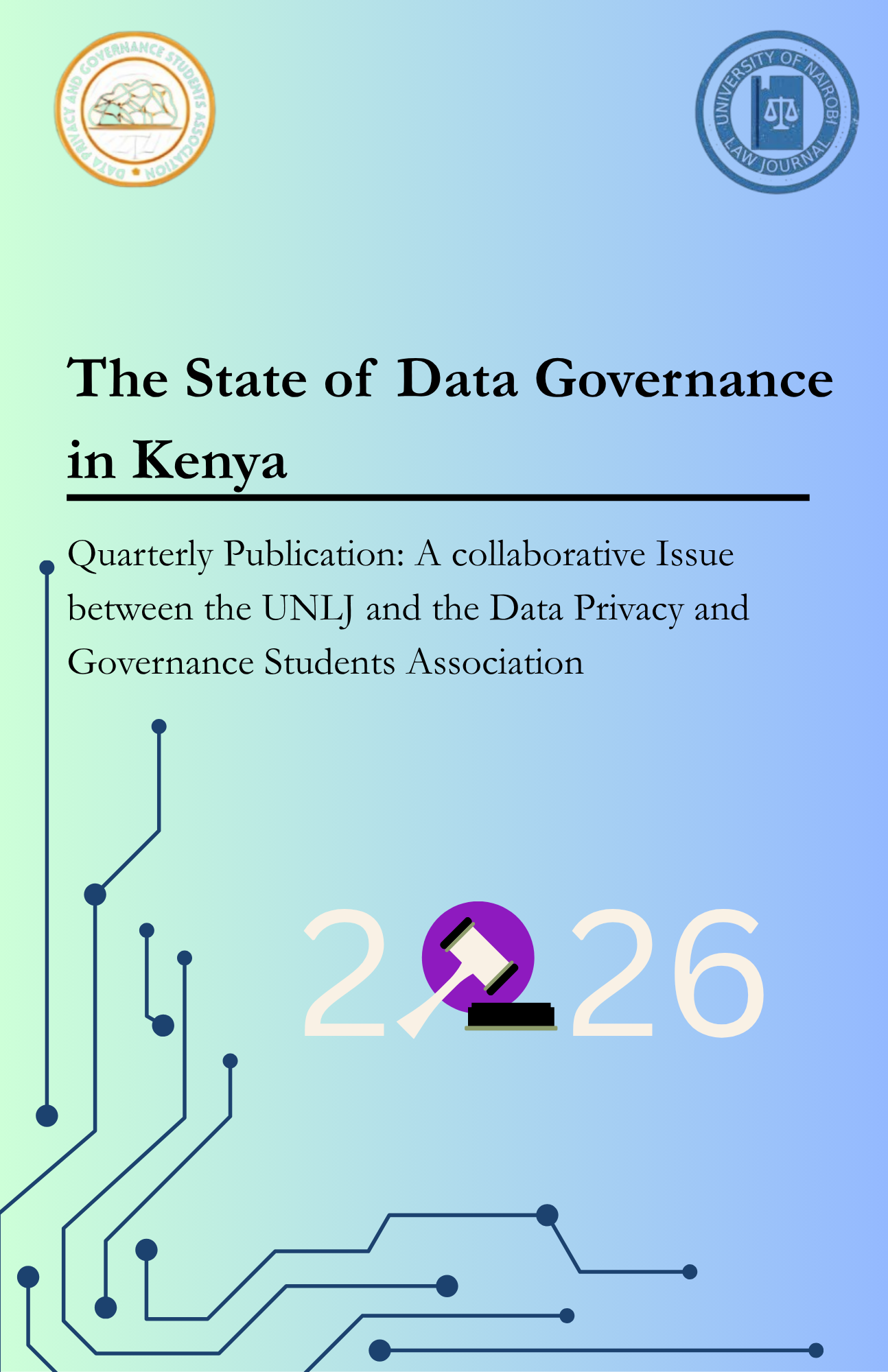
The State of Data Protection in Kenya
Vol. 1 No. 1 (2026)This quarterly issue marks the culmination of a fruitful collaboration between the University of Nairobi Law Journal and the Data Privacy & Governance Students Association. The two institutions came together to deepen discourse in data governance. This area is a dynamic sub-discipline of law that continues to burgeon and earn wide acclaim from civil society in Kenya and world over. This edition presents one of the most vibrant collections to date, of insightful research from undergraduate students. -

RESEARCH FAIR 2023: ADVANCING HUMAN RIGHTS AND SOCIAL JUSTICE FOR SUSTAINABLE DEVELOPMENT
Vol. 10 No. 3 (2023)Despite notable progress in sustainable development initiatives, several challenges persist. Many communities, especially those that are marginalized and vulnerable, continue to grapple with discrimination, exclusion, and limited access to basic human rights and essential services. Alarming statistics indicate that as of 2022, approximately 8% of the global population lived in extreme poverty, facing issues like food insecurity, inadequate healthcare, and limited educational opportunities (Poverty and Shared Prosperity Report, 2022). Moreover, economic disparities and gender inequalities remain prevalent, impeding social progress. According to the World Economic Forum's 2022 Global Gender Gap Report, gender parity was projected to take another 132 years to achieve at the then-current rate of change. Furthermore, environmental degradation exacerbates these challenges, with over 1 million species facing the risk of extinction due to human activities (IPBES, 2019). Failure to address these fundamental issues jeopardizes the effectiveness of sustainable development efforts and leaves the most vulnerable populations behind. It is therefore urgent to mainstream human rights and social justice considerations to ensure that the benefits of sustainable development are equitably distributed. For this reason, seasoned legal scholars and upcoming advocates alike contributed the papers herein in order to address the systematic threats to the advancement of human rights.
-
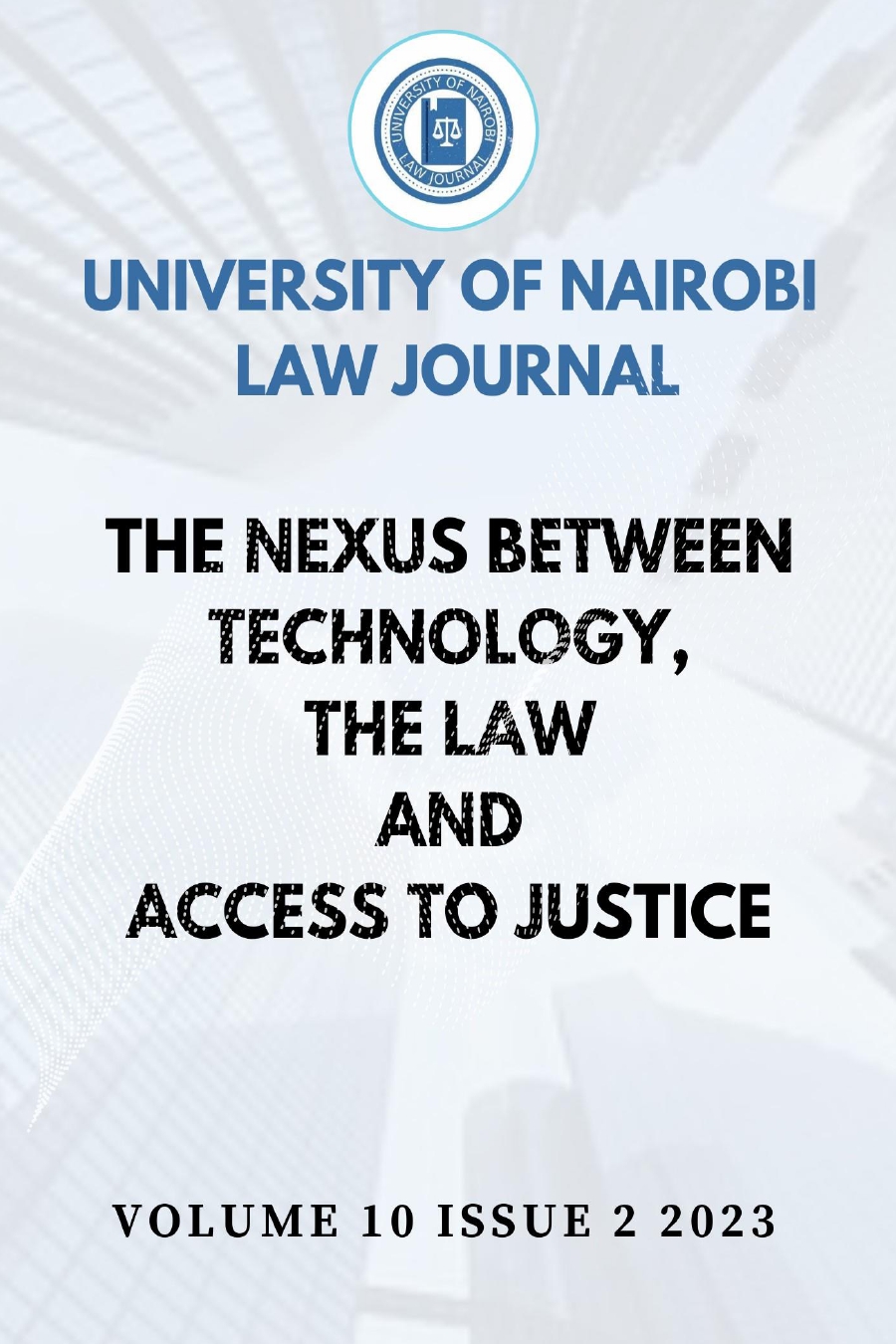
THE NEXUS BETWEEN TECHNOLOGY, THE LAW AND ACCESS TO JUSTICE
Vol. 10 No. 2 (2023)Dear Readers,
Welcome to the captivating realm where law and technology intertwine in the
latest issue of the University of Nairobi Law Journal. In this dynamic compilation,
we explore the multifaceted interactions between legal principles and the everevolving world of technology, uncovering intriguing insights illuminating the
path forward in this digital age.
Within these virtual corridors, you will discover a collection of articles that
illuminate the dynamic interplay between the legal realm and the digital age. "The
Law and Technology; A Boon or Bane: Kenya's Case Study" takes us on a
whirlwind tour of Kenya's technological evolution, unravelling the complexities
that arise when law and technology become dance partners. "The Digitization of
Employment: A Case of the Gig Economy" invites us to explore the
metamorphosis of work in the digital era, where pixels and paychecks interlace in
fascinating ways.
In "Pathway to Digital Justice: An Analysis of Amicable Dispute Settlement," we
venture into the labyrinthine world of digital justice mechanisms, where codes
and courthouses coalesce to redefine access to justice. "Culpability in the Era of
Artificial Intelligence in Kenya" delves into the intricate dance of accountability
and AI, illuminating the legal pathways that navigate the blurred boundaries of
the digital intellect.
Lastly, "Promoting Breastfeeding as a Human Right in Kenya" serves as a
poignant reminder that amidst the technocratic crescendo, the timeless tenets of
human rights remain steadfast.
We invite you to immerse yourselves in these thought-provoking narratives, to
engage in discourse that echoes within the chambers of academia and resonates
with the ever-evolving legal landscape. As you navigate this fusion of
jurisprudence and innovation, may you find inspiration, challenge, and a renewed
appreciation for the harmonious discord that is law and technology. Happy
reading! -
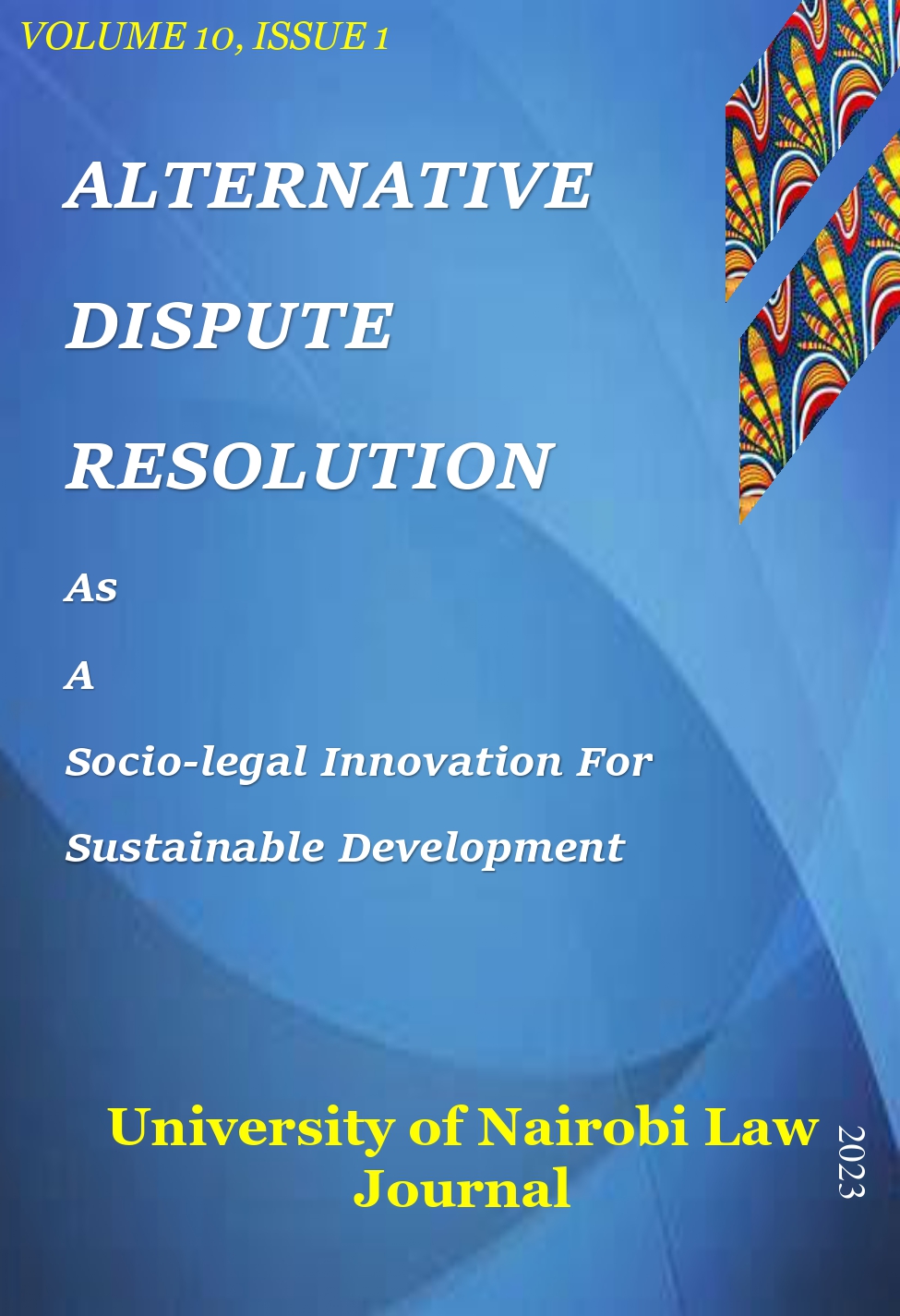
ALTERNATIVE DISPUTE RESOLUTION AS A SOCIO-LEGAL INNOVATION FOR SUSTAINABLE DEVELOPMENT
Vol. 10 No. 1 (2023)In keeping with our theme of Alternative Dispute Resolution as a Tool for Socio- Legal Innovation for Sustainable Development, our dedicated team gathered a plethora of articles ranging from the role of ADR in resolving climate-related disputes to the relationship between artificial intelligence and alternative dispute resolution mechanisms. Indeed, this article contains interesting reads about ADR, such as Social Dialogue for the Social Sector, the Dawn of Artificial Intelligence in Alternative Dispute Resolution; Expanding Access to Justice Through Technology, The Role of ADR in the Realization of Socioeconomic Rights, The Application of ADR in Resolving Climate-related Disputes to Achieve Sustainable Development in Kenya, and Kenya's CBC Crisis as a Call to the Boardroom, Not the Courtroom.


